Inspiration
& Education

Guides and resources from LEE.

Inspiring Professionals

Inspiring Professionals 2

DVD: Chasing the Light

DVD: Landscape in Mind

Big Stopper

The Big Stopper is a long exposure filter that reduces the amount of light entering your lens by approximately ten stops. This gives broad scope to create incredible images using slow shutter speeds or wide apertures.

Watch the Big Stopper Video

Inspiring Professionals

Why use a Big Stopper?

By greatly extending exposure times the Big Stopper has the effect of allowing anything that is moving in your image to become blurred or ghost like, for example clouds, waterfalls, rivers, and the sea.

The filter can also be used on cityscapes to blur people or on roads and motorways to blur traffic.

Big Stopper Pro Glass

The Big Stopper

Shot with a Big Stopper
Jeremy Walker

The LEE Big Stopper increases the exposure by ten stops, this allows the slight motion of the sea and sky to be captured.

Exposure: 2 minutes at f11

Shot without a Big Stopper

How to use the Big Stopper

  1. Before fitting the Big Stopper, first compose your image.
  2. Take a meter reading without the filter in place, and set your desired aperture and shutter speed.
  3. Multiply your exposure by a factor of ten. For example, if your meter reading suggests an exposure of 1/125sec at f/11, with the Big Stopper fitted, your exposure becomes eight seconds at f/11. If your meter reading suggests an exposure of two seconds at f/11, with the Big Stopper fitted, your exposure becomes a whopping 32 minutes.
  4. With the Big Stopper inserted into the slot nearest the lens, attach the filter holder as usual and make your exposure.
  5. Always use the sturdiest tripod you can when making long exposures, and take care not to knock the camera or tripod. Cover your viewfinder before releasing the shutter to avoid light encroaching onto the sensor or film and causing flare.

The Big Stopper can be used in conjunction with other filters such as Neutral Density Graduated Filters. Other filters should be set up and positioned in the filter holder as normal before using the Big Stopper, remembering to keep the slot in the filter holder nearest the lens free for the BIG Stopper.

Big Stopper in Holder

Exposure Guide

Normal Shutter
Speed
with
Big Stopper
1,000th 1 second
500th 2 seconds
250th 4 seconds
125th 8 seconds
60th 15 seconds
30th 30 seconds
15th 1 minute
8th 2 minutes
¼ 4 minutes
½ 8 minutes
1 second 16 minutes
2 seconds 32 minutes

Before

Before LEE Big Stopper

After – Big Stopper & LEE 0.9 ND Grad Hard, Colour Corrected

After LEE Big Stopper

Professional hints:

White balance

Use of the Big Stopper may result in a slight colour cast. It's worth conducting some tests to learn either which colour-correction filters to use in conjunction with the Big Stopper, or which white balance settings to apply. If shooting Raw, any colour cast can be corrected easily at the postproduction stage.

Reciprocity failure

When making long exposures, film users need to take reciprocity failure into account. Different brands and speeds of film respond differently to long exposures, so always refer to the manufacturers' recommendations first. To be completely sure, carry out tests with your chosen emulsions and bracket your exposures.

Quick Start Videos

Get up to speed fast with our videos that explain the LEE Filter System and how to use it

Product Directory

Complete product information for filters, holders, kits, sets and accessories

Advice from Professionals

A Full Range of Stopping Power

Neutral Density Standard Filters

ProGlass Neutral Density Filters

We offer ND filters with a full range of stopping power

The Big Stopper is a very dense neutral density filter (10 stops). Other ND filters are also available from 0.3 ND (1 stop) to 0.9 ND (3 stops).

Ultimate flexibility

ND Filters can be stacked together, or used with other filters, so you can respond to almost any lighting situation.

Specialist filters for digital

When shooting digitally, light at the infrared and ultraviolet ends of the spectrum can be problematic. The ProGlass range of filters has been designed with this in mind. These glass neutral density filters are optimised for use with digital cameras, as they absorb more infrared and ultraviolet light than traditional ND filters. The result is a punchier image, with less discolouration in adverse lighting conditions.

Before

Before LEE ND Standard

After – LEE 0.9 ND Standard

After LEE ND Standard

Polariser

Polarising filters are used primarily to reduce reflections. This can be useful when photographing skies, water, glass etc.

Workshops

Join leading landscape photographer Jeremy Walker for a day or weekend at our photographic workshops around the UK.

Inspiring Professionals 2

A new hardback book containing stunning photographs by professionals with explanations of filters and techniques used.

The System

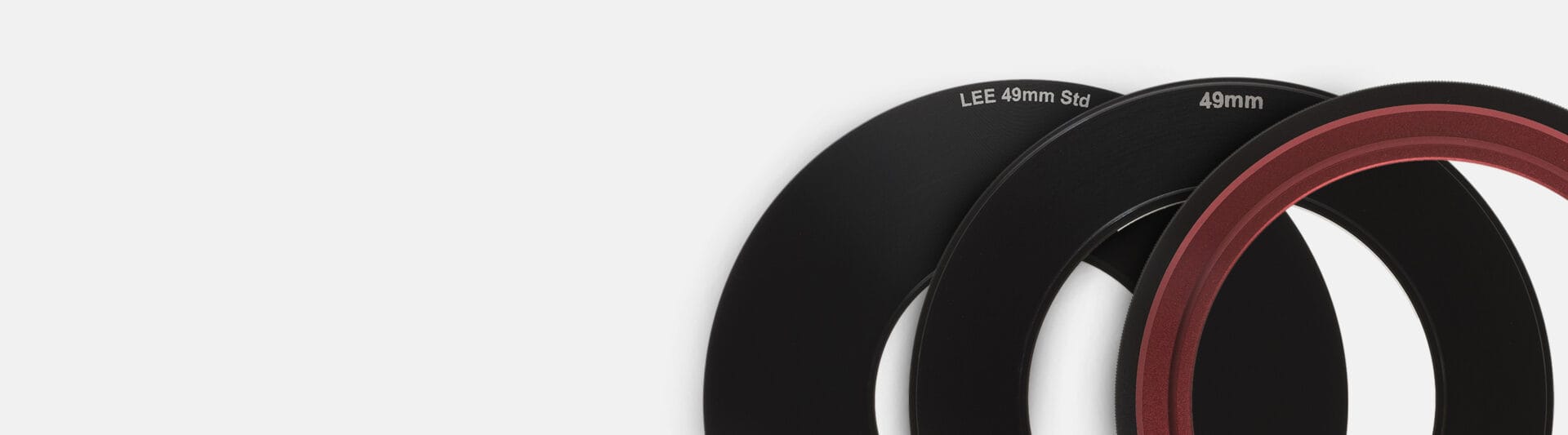
  • Adaptor Ring

    screws onto camera lens

  • Filter Holder

    attaches to the adaptor ring

  • LEE Filter

    slides into the filter holder

More info

LEE Filters Quick Start Videos

You can view all our videos with Closed Captions and Translations (beta) on our YouTube Channel LEEfiltersTV

Find a dealer